How to Reduce the Risk of SLA Penalties in PPP Contracts Without Increasing Headcount
 Giovana Fonseca•
Also available in: Português · Español

Public-Private Partnerships (PPPs) have revolutionized the delivery of urban services in Brazil, particularly in the public lighting sector. However, the transition from the traditional service delivery model to administrative or sponsored concessions brought a strict contractual requirement: rigorous compliance with the SLA (Service Level Agreement), under pain of heavy SLA penalties.
In most public lighting PPP contracts, the concessionaire’s remuneration structure is directly tied to Key Performance Indicators (KPIs). Factors such as Mean Time to Repair (MTTR), lighting point availability rates, and asset registry accuracy determine the monthly fee paid by the granting authority. Ongoing failure to meet contractual targets triggers two financial setbacks: direct fines and progressive deductions from periodic payments (known as bad performance deductions).
Given this premise, time and quality management ceases to be a mere operational goal and becomes the core guarantee of the project’s financial viability. Yet, operational managers face a major dilemma: how to reduce the risk of SLA penalties without inflating payroll and fleet costs by hiring additional field crews? The answer does not lie in the unchecked expansion of human infrastructure, but in redesigning operational workflows and unlocking efficiency gains from already installed capacity.
The Role of SLAs in Public-Private Partnerships: Concept, Typologies, and Strategic Function
What is an SLA (Service Level Agreement)?
A Service Level Agreement (SLA) is a formal, binding instrument that establishes—through quantitative and auditable metrics—the quality standards, execution deadlines, and availability levels that the private concessionaire must deliver to the public contracting authority. Rather than evaluating operations subjectively, the SLA translates contractual obligations into clear operational KPIs, such as maximum response times for emergency tickets, the percentage of lit luminaires per circuit, and deadlines for restoring damaged infrastructure.

Types of SLAs in the Urban Infrastructure Context
Within complex, long-term contracts, SLA structures vary according to the scope and specificity of the service provided:
- Service-based SLA: Applies a standardized parameter across the entire managed network, regardless of geographic location or user category. In the public lighting sector, this translates into the deadline to repair a dark luminaire on residential streets or the minimum continuous uptime rate across the entire grid.
- Customer/Location-based SLA: Establishes differentiated service levels based on sub-regions, high-traffic zones, or critical facilities. In lighting PPPs, areas with heavy pedestrian traffic, expressways, hospital surroundings, and public safety hubs carry substantially stricter response deadlines than secondary roads.
- Multi-level SLA: Organizes requirements into hierarchical tiers—corporate, service, and operational. This approach isolates accountability: while the corporate tier monitors overall lighting system availability before the municipality, the operational tier enforces specific targets on subcontractors, fleets, and maintenance crews.
Why Are SLAs Indispensable in PPPs?
Public lighting concessions are designed to last between 13 and 30 years. Over this timeframe, the SLA performs critical governance functions:
- Aligning Profit with Performance: The private partner’s compensation does not rely solely on executing the initial modernization works (LED retrofitting), but on sustaining quality over decades. The SLA ensures that the concessionaire’s financial return is directly conditioned on serving the public interest.
- Mitigating Asset Deterioration Risk: Since assets revert to public ownership at the end of the concession, SLA parameters prevent progressive network degradation by mandating continuous preventive maintenance cycles.
- Objective Contractual Mechanism: The SLA establishes an objective mathematical basis for calculating payment deductions (glosas) and regulatory fines, streamlining audit processes conducted by Independent Verifiers and oversight bodies.
Operational Challenges and the Real Impact of SLA Penalties on Cash Flow
Despite clear contractual rules, daily field execution imposes severe bottlenecks on concessionaires. Without analytical control over operational routines, SLA penalties stop being an exception and become a recurring cost that undermines the business’s financial health.
Key Field Operation Bottlenecks
Missing SLA deadlines is typically a symptom of structural flaws in service workflows:
- Lack of Real-Time Traceability and Visibility: The absence of centralized tracking of exact crew locations and work order statuses prevents dynamic rerouting when urgent tickets arise.
- Inefficient Travel and Reactive Routing: Route planning based solely on supervisors’ intuition leads to unnecessary fleet overlap across the city, longer transit times, and wasted productive work hours.
- Disconnect Between Inventory and Field (Wasted Trips): Maintenance crews frequently arrive at a job site only to discover they lack the right parts (specific drivers, connectors, cables, or luminaire models), resulting in unproductive visits and rescheduling.
- Lack of Service Standardization (Rework): The absence of thorough inspections and standardized operational checklists leads to partial fixes—causing the same luminaire to fail again days later, generating repeat tickets within the same SLA window.
- Weak Technical Proof During Audits: Repairs are often completed within contractual deadlines, yet the lack of georeferenced, timestamped evidence invalidates service acceptance by the Independent Verifier, resulting in undue SLA penalties for “lack of proof.”
The Hidden Cycle of Costs and Errors
SLA non-compliance goes beyond direct revenue loss from payment deductions. It triggers an ongoing cycle of hidden operating expenses (OPEX):
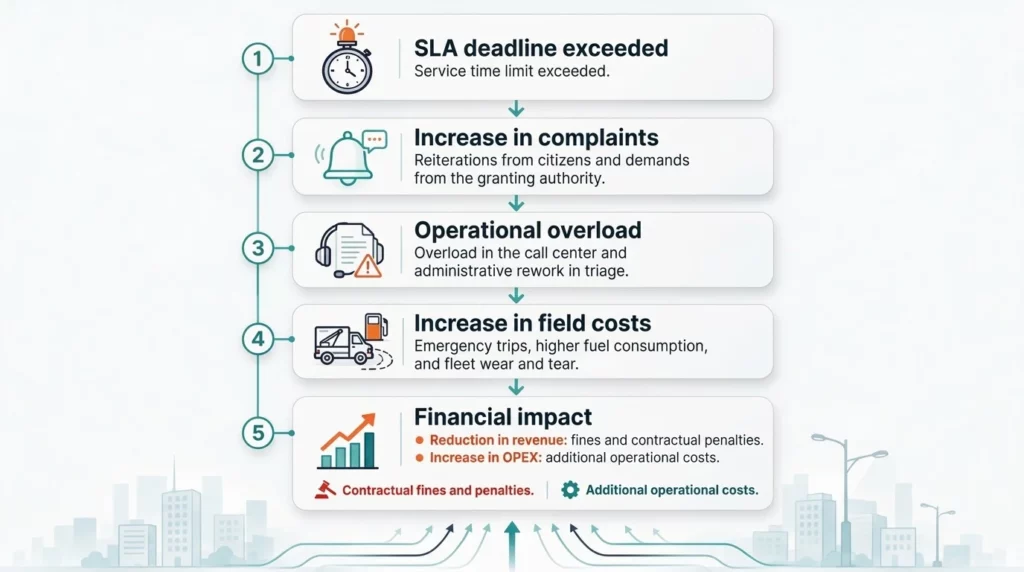
To break this cycle of losses without expanding payroll, the concessionaire must transform its management structure—shifting from a purely reactive stance to a predictive, automated, and rigorously auditable model.
Operational Strategies to Guarantee SLAs Without Expanding Your Team
Increasing the productive capacity of existing crews depends on eliminating non-productive time (transit, idle time waiting for parts, manual form-filling) and structuring preventive processes.
1. Dynamic Routing and Proximity-Based Dispatch
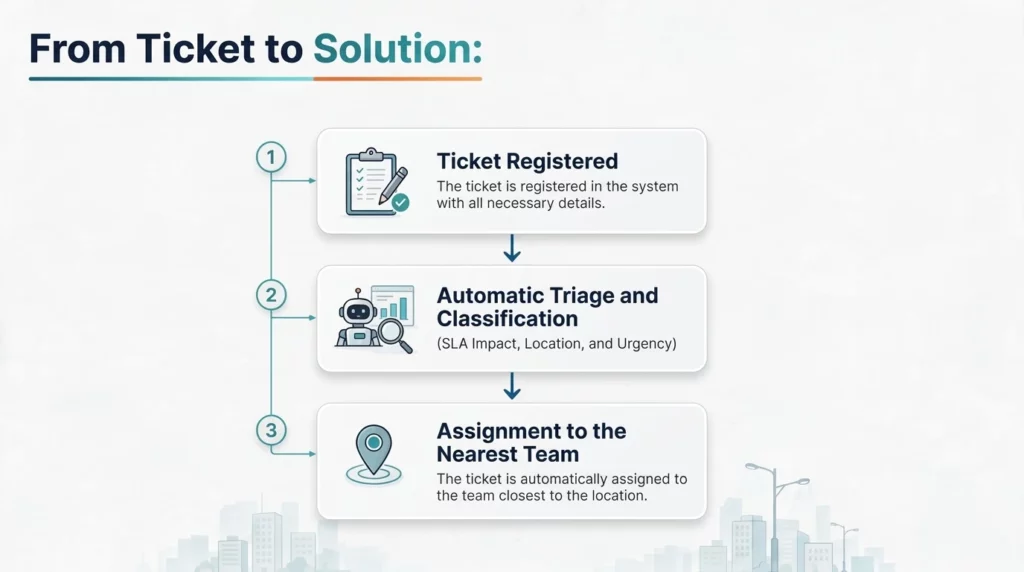
Automated, intelligent allocation of work orders (WOs) ensures that the nearest technician with the right skill set receives the task on their mobile device. Instead of following rigid itineraries or covering vast areas without planning, the fleet travels along routes optimized by geographic algorithms, increasing effective wrench time on the infrastructure.
2. Active Monitoring with Countdown Timers (SLA Clock)
To avoid end-of-month SLA penalties, deadline tracking must be continuous. Visual countdown timers per work order—featuring color-coded alerts based on criticality and approaching expiration—allow the control center to proactively reprioritize tasks before contractual deadlines expire.
3. Intelligent Triage and Priority Classification
Not all tickets carry the same weight in monthly remuneration. Service workflows must apply automated prioritization rules based on contractual impact: an outage on a major avenue or near a hospital, for instance, must receive immediate, automatic priority over isolated failures on secondary streets with lower KPI impact.
4. Full Integration Between Inventory and Work Orders
Pre-reserving materials upon work order creation eliminates wasted trips. By linking required supplies to the WO before the crew leaves the depot, the system guarantees component availability and automatically deducts inventory in real time upon job completion.
5. Digital Auditing and Geofencing to Safeguard Against Deductions
Proving SLA compliance requires indisputable digital evidence. Using mobile forms with geofencing, GPS coordinate validation, and mandatory “before and after” photos featuring tamper-proof timestamps shields the concessionaire against unwarranted deductions imposed by Independent Verifiers.
6. Transitioning from Reactive to Predictive Maintenance
Progressively replacing the “fix-it-when-it-breaks” model with preventive and predictive maintenance routines—fed by failure history and telemanagement data—substantially reduces emergency tickets. Addressing imminent failures during scheduled patrols costs significantly less and prevents new tickets from entering the SLA clock.
How Exati Transforms Operational Management in PPP Contracts
Putting these efficiency strategies into practice requires a platform purpose-built for the operational complexities of public lighting and urban services.
Exati Software acts as the operational intelligence hub for PPP concessionaires, unifying all customer service and field maintenance management on a single platform:
- Exati AI Dispatcher: Advanced automation for work order distribution, triage by contractual priority level, and intelligent routing based on real-time location.
- Integrated Supply Chain Module: Direct link between the warehouse and open tickets, ensuring advance material reservation and accurate tracking of inventory consumed by street crews.
- Dynamic SLA Dashboard: Real-time visibility into the status of every ticket via countdown timers (SLA Clock), enabling proactive action against deadline breaches.
- Field App with Digital Proof Collection: Execution of operational routines supported by mandatory checklists, geofencing, and timestamped, GPS-tagged photo syncing for rapid approval in Independent Verifier audits.
Consolidating these processes reflects directly on concessionaires’ operational metrics. Leveraging Exati’s technologies delivers up to 80% greater agility in route planning, a 30% reduction in fleet travel costs, and roughly a 20% direct increase in field crew productivity.
Conclusion: How to Permanently Avoid SLA Penalties
Protecting a PPP contract’s profitability against SLA non-compliance fines does not necessarily require expanding headcount or vehicle fleets. It is about eradicating wasted productive time, eliminating rework, and applying analytical intelligence to operational dispatch.
By modernizing field management with specialized tools, concessionaires deliver the service levels demanded by the granting authority and the public—preserving project margins and ensuring the long-term sustainability of the concession.
Want to avoid SLA penalties and optimize your field operation’s performance? Speak with Exati’s specialists and discover how our platform can support the management and financial protection of your PPP contract.